



Maple Leaf Wheelchair Authorized Dealer | Custom Wheelchairs & Seating
Custom wheelchairs, built to measure in Canada
Maple Leaf Wheelchair build tilt-and-recline chairs, manual frames, commodes and seating to order in their own Canadian factory — sized and specified to the person who will use them. We are their dealer in Metro Vancouver, and we handle the measuring, the order form and the fitting.
- Built to measure
- Made in Canada
- 5-year frame warranty
- About 3 weeks start to finish
Maple Leaf products are a custom build wheelchair manufacturer, so only basic frames are in stock and the rest is customized to the specifications of the client per the order form you or the therapist fill out. Typically it takes 2 weeks to manufacture the chair and then 5–7 days for delivery to you.
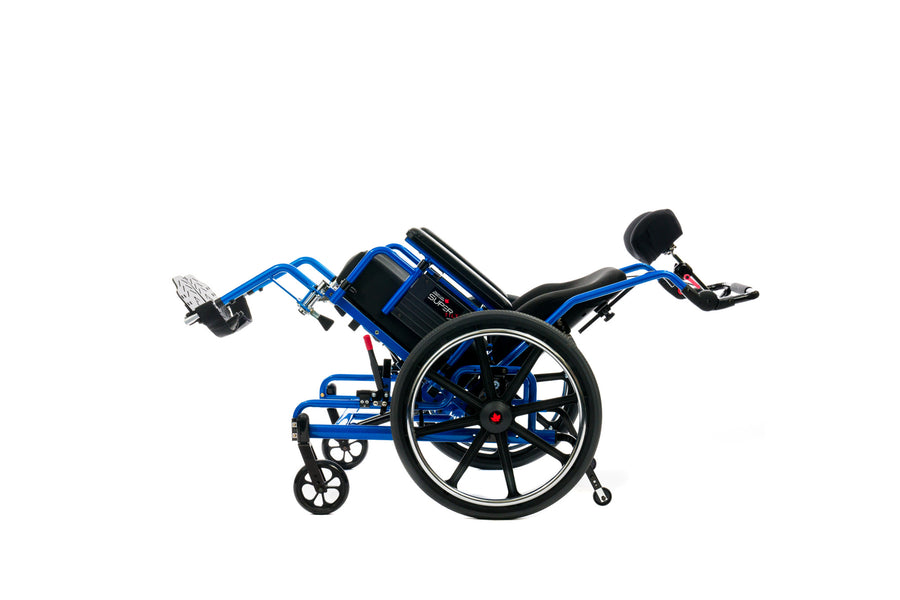
Tilt chairs — special order
SuperTilt
Maple Leaf Wheelchair's flagship chair, and the one most often specified where someone sits for the majority of the day. It offers infinite tilt up to 45 degrees, and the quality of that tilt is why clinicians ask for it by name — smooth and consistent through the whole range, which matters when a caregiver repositions someone a dozen times a day.
The steel frame is what lets it carry a heavy-duty package to 500 lb and what makes it a chair specified for years of daily use rather than a few months of recovery. Pair it with a properly chosen back and cushion and it becomes a pressure-management system, not just a way of moving someone around.
Standard features
- 45° of infinite tilt
- Steel frame construction
- Pin or plug-in style footrests
- Anti-tippers
- Adjustable stroller handle for the caregiver
Frame options
- Heavy-duty package, to 500 lb
- Power tilt — for a caregiver who cannot manage it manually
- 12" rear wheel, inside frame mount
- Expandable frame, where a child is still growing
- Endomorphic back canes for additional trunk support
- Reclining back, added to the tilt rather than instead of it
Often paired accessories
- Fusion line of backs
- Multi-axis headrest
- Articulating legrests
- Angle-adjustable footplates
- Nylon padded leg strap and leg bolster
- Padded arm trough
- Extra-wide gel arm
Model specifications
- Tilt range45° infinite
- FrameSteel
- Seat width14–18"
- Seat depth16–18"
- Seat to floor13–18.25"
- Capacity, standard250 lb
- Capacity, heavy dutyUp to 500 lb
- Chair weight50 lb complete
- Overall widthSeat width + 9"
- Build timeAbout 2 weeks
- Frame warranty5 years
- Parts warranty2 years
What tilt actually does
Tilt rotates the whole seat and back together, keeping the hip and knee angles fixed while shifting weight off the sitting bones and onto the back of the trunk. That is different from recline, which opens the hip angle and can cause shearing against the backrest.
The practical point: someone who cannot shift their own weight needs pressure taken off regularly, and tilt lets a caregiver do that in seconds without a transfer. It is the main defence against pressure sores for people seated most of the day.
Three questions that decide the chair
- Will they self-propel? If yes, the chair needs large rear wheels and hand rims. If a caregiver pushes, four casters are lighter and turn tighter indoors.
- How do they transfer? A lower seat-to-floor height makes sliding across to a bed or toilet far easier.
- How many hours a day in the chair? Past about six, seating stops being an accessory and becomes the most important part of the order.
Tilt chairs — special order
LowRider
The dynamic-style tilt chair, built around a front pivot point so the seat rises very little as the chair tilts back. On a conventional tilt frame the seat climbs as it goes; here it stays close to where it started. That is what makes it the frame to ask about when transfers are sliding rather than standing, when the chair has to get under a table, or when a shorter user needs their feet on the floor to help propel.
The trade-off is worth understanding before you order. Tilt range on this chair is tied to seat height: set the seat low, at 13 to 15.5 inches, and you get 20 degrees of tilt. Set it higher, at 16 to 18.25 inches, and you get 30 degrees. You cannot have the lowest seat and the most tilt at the same time — so which matters more, transfers or pressure relief, is the conversation to have first.
Standard features
- 20° of tilt at a 13–15.5" seat-to-floor height
- 30° of tilt at a 16–18.25" seat-to-floor height
- Front pivot point — minimal seat rise through the tilt
- Pin or plug-in style footrests
- Anti-tippers
- Adjustable stroller handle for the caregiver
Frame options
- Heavy-duty package
- Power tilt — for a caregiver who cannot manage it manually
- Endomorphic back canes for additional trunk support
- Reclining back
Often paired accessories
- Fusion line of backs
- Multi-axis headrest
- Articulating legrests
- Angle-adjustable footplates
- Fender protectors for the rear wheels
- Nylon padded leg strap and leg bolster
- Padded arm trough
- Extra-wide gel arm pads
Model specifications
- Tilt, low seat setting20° at 13–15.5"
- Tilt, high seat setting30° at 16–18.25"
- Seat width14–18"
- Seat depth16–18"
- Seat to floor13–18.25"
- Capacity, standard250 lb
- Chair weight50 lb complete
- Overall widthSeat width + 9"
- Build timeAbout 2 weeks
- Frame warranty5 years
- Parts warranty2 years
Choosing between the two settings
- Low seat, 20° tilt. Choose this where sliding transfers to a bed or toilet happen several times a day, or where the user foot-propels and needs to reach the floor.
- Higher seat, 30° tilt. Choose this where pressure relief through the day matters more than transfer height — more tilt means more weight comes off the sitting bones.
- Need both? If someone needs a low seat and deep tilt, the LowRider will not give you both — that is the point at which we would look at the SuperTilt instead.
LowRider or SuperTilt?
The SuperTilt gives up to 45° of tilt and takes a heavy-duty package to 500 lb. The LowRider gives 20° or 30° and stands at 250 lb standard, but keeps the seat low through the tilt.
So: pressure management and higher weight point to the SuperTilt. Transfers, table clearance and foot propulsion point to the LowRider. Most people already know which of those dominates their day.
Tilt chairs — special order
MLT
A geriatric tilt-and-recline chair on a steel frame, built around long sitting days rather than independent mobility. It gives 35 degrees of infinite tilt with a reclining back as standard — both together, not one instead of the other — and tension straps through the back let the surface be shaped to the person instead of forcing them to fit a fixed panel.
Two details mark it out as a chair for someone being cared for rather than someone getting about. The legrests are a one-piece elevating system on gas cylinders, so a caregiver raises both legs in a single movement. And the shoulder wings are contoured and adjustable, which holds the trunk steady for a person who can no longer hold their own position.
Standard features
- 35° of infinite tilt
- Reclining back — included, not an extra
- One-piece elevating legrest system on gas cylinders
- Adjustable contoured shoulder wings for trunk support
- Tension-adjustable back straps
- Anti-tippers
Frame options
- MLT700A — large rear wheels with urethane casters, for a user who can propel a little
- MLT700B — four casters: three total-locking plus one directional-locking, for a chair that is pushed
Often paired accessories
- Auto-style seat belt
- Adjustable IV pole
- Oxygen tank holder
- Slide-on padded tray
Model specifications
- Tilt range35° infinite
- ReclineStandard
- FrameSteel
- Seat width16" & 18"
- Seat depth16", 18" & 20"
- Capacity, standard250 lb
- Chair weight60 lb complete
- Width, large rear wheelsSeat width + 10"
- Width, four castersSeat width + 6"
- Build timeAbout 2 weeks
- Frame warranty5 years
- Parts warranty2 years
The wheel choice changes the width by four inches
With large rear wheels the chair is the seat width plus 10 inches. With four casters it is the seat width plus 6. On an 18-inch seat that is 28 inches across versus 24 — and a standard interior door is often only 24 to 26.
So the wheel decision is not only about whether the person can propel themselves. In a home with narrow doorways or a tight bathroom, four casters may be the only version that gets where it needs to go. Measure first.
When the MLT is the right chair
- The person is seated for most of the day and someone else moves them
- Legs need elevating regularly — swelling, circulation, comfort
- Trunk control has gone and the person slumps sideways without support
- Oxygen, an IV pole or a tray need to travel with the chair
Tilt chairs — special order
MLTR
The institutional version of the MLT, and the one Maple Leaf point at hospitals and rehab facilities. It gives 30 degrees of infinite tilt with a reclining back, and arrives complete with seating rather than needing a cushion and back specified separately.
What sets it apart is the seat depth: infinitely adjustable from 15 to 19 inches, where the MLT offers three fixed depths. On a ward that is the whole point — one chair can be set to fit whoever is in it this week and reset for the next person, without ordering a different frame. A locking tray assembly comes as standard for the same reason.
Standard features
- 30° of infinite tilt
- Reclining back — included
- Infinite seat depth adjustment, 15–19"
- Complete seating included
- One-piece elevating legrest system on gas cylinders
- Adjustable contoured shoulder wings for trunk support
- Locking tray assembly
- Anti-tippers
Frame options
- MLTR500 — four casters: three total-locking plus one directional-locking, for a chair that is pushed
- MLTR600 — large rear wheels with urethane casters, for a user who can propel a little
Note the codes run the opposite way round to the MLT, where 700A is the rear-wheel frame and 700B the caster frame. Worth checking twice on an order form.
Often paired accessories
- Auto-style seat belt
- Adjustable IV pole
- Oxygen tank holder
Model specifications
- Tilt range30° infinite
- ReclineStandard
- FrameSteel
- Seat width16" & 18"
- Seat depth15–19" infinite
- Capacity, standard250 lb
- Chair weight60 lb complete
- Width, large rear wheelsSeat width + 12"
- Width, four castersSeat width + 8"
- Build timeAbout 2 weeks
- Frame warranty5 years
- Parts warranty2 years
Why facilities choose this one
- The depth adjusts to whoever is in it. 15 to 19 inches, infinitely — so one chair serves a rotating population instead of sitting idle because it does not fit the current patient.
- Seating is included. No separate cushion and back to specify, source or lose.
- The tray locks on. Standard, not an accessory to order and then misplace on a ward.
It is the widest chair in the range
Seat width plus 12 inches with large rear wheels, plus 8 with four casters. An 18-inch seat is therefore 30 inches or 26 across — two inches wider than the equivalent MLT either way.
That is fine in a hospital corridor and often a problem in a house. If this chair is going into a home rather than a facility, measure the doorways before anything is ordered.
| MLT | MLTR | |
|---|---|---|
| Tilt | 35° infinite | 30° infinite |
| Seat depth | 16", 18" & 20" fixed | 15–19" infinite |
| Seating | Specified separately | Included complete |
| Tray | Optional slide-on | Locking, standard |
| Width, rear wheels | Seat + 10" | Seat + 12" |
| Width, four casters | Seat + 6" | Seat + 8" |
| Frame codes | 700A rear wheels / 700B casters | 600 rear wheels / 500 casters |
| Best suited to | One person, long term, at home | Shared use, hospital or rehab |
SuperTilt in detail
Click any photograph to enlarge, then use the arrows to move through the set.
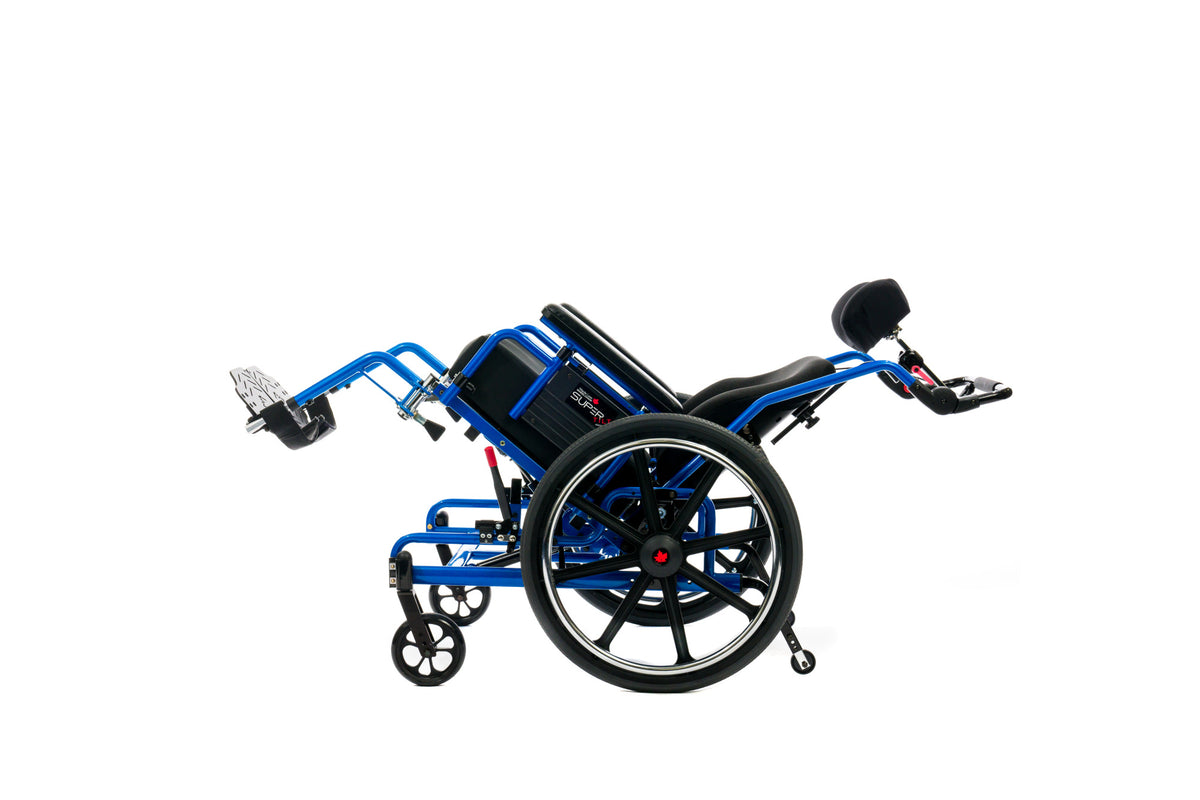

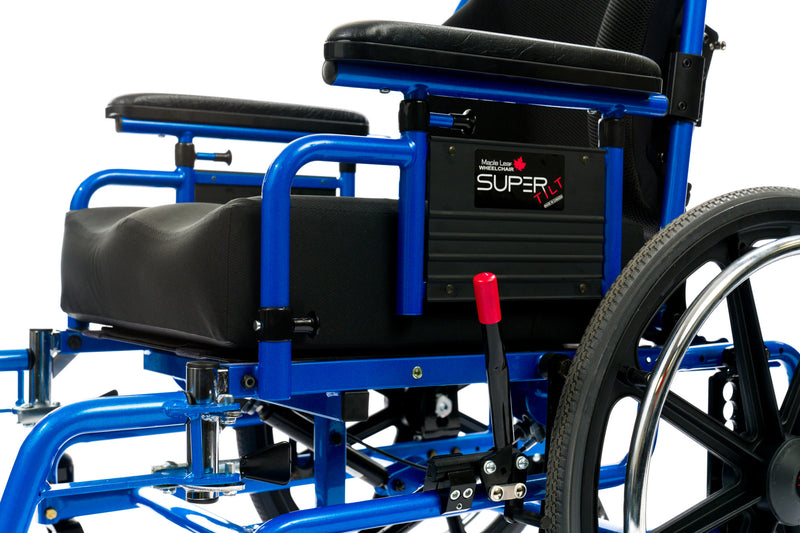
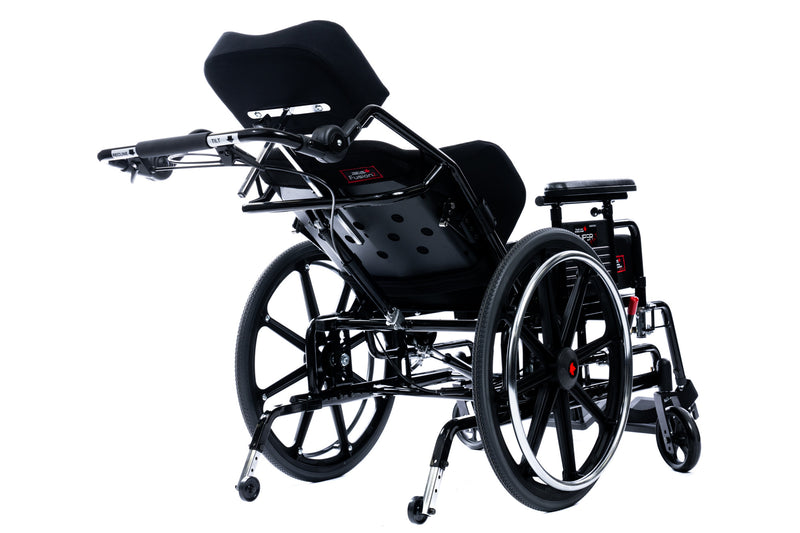
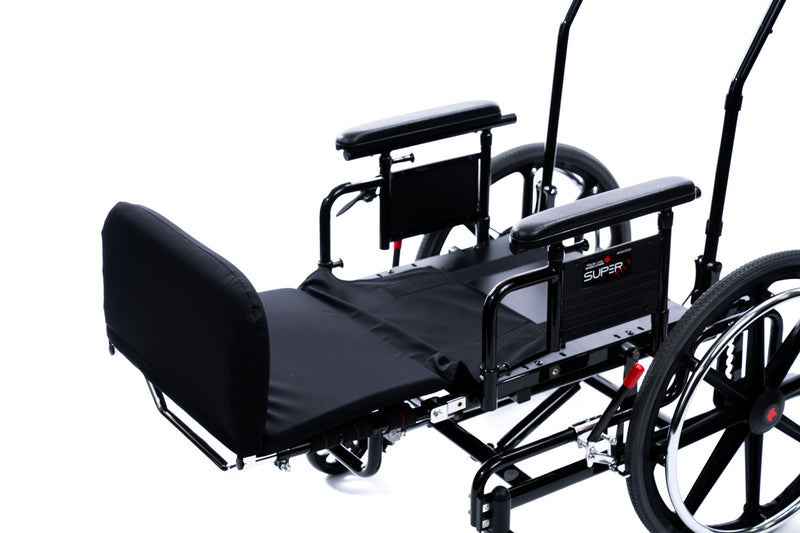
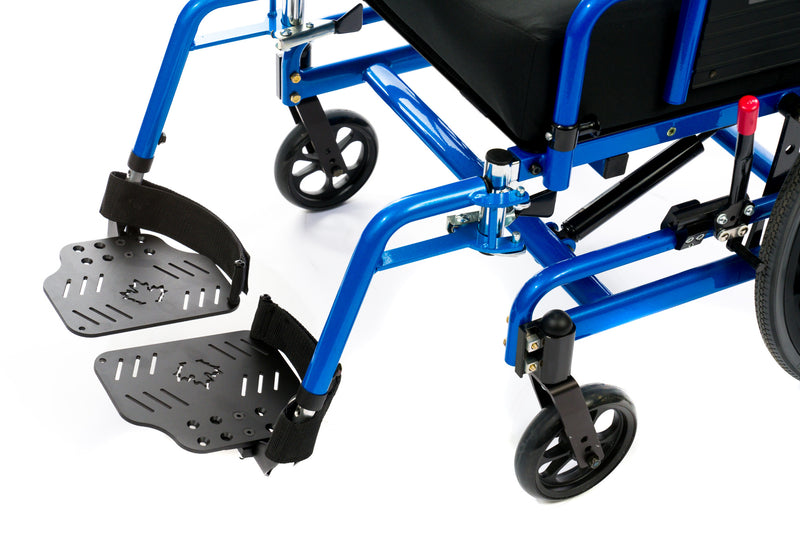

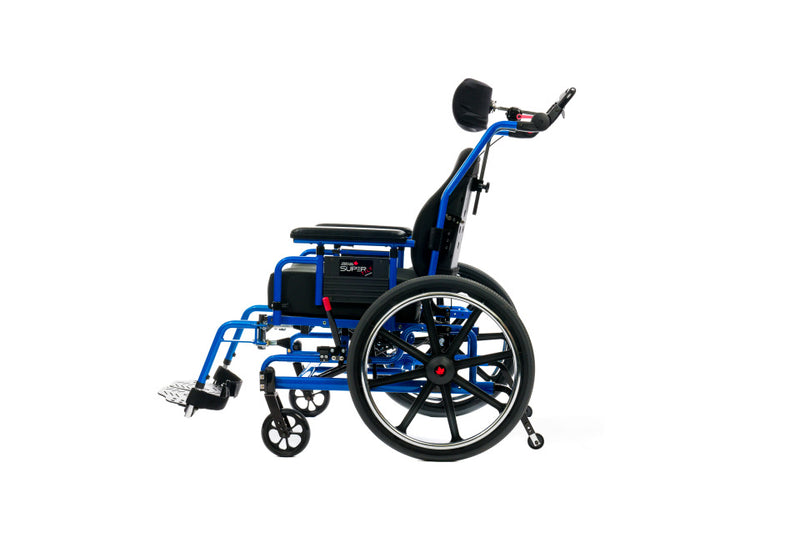
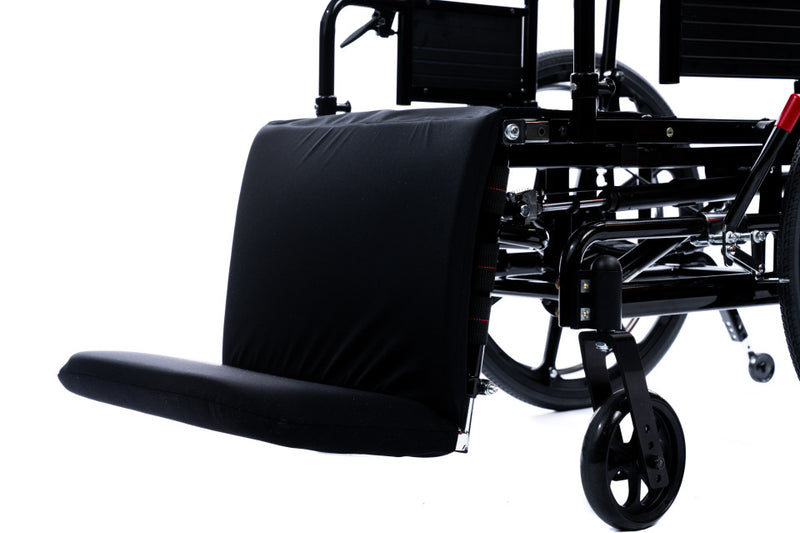
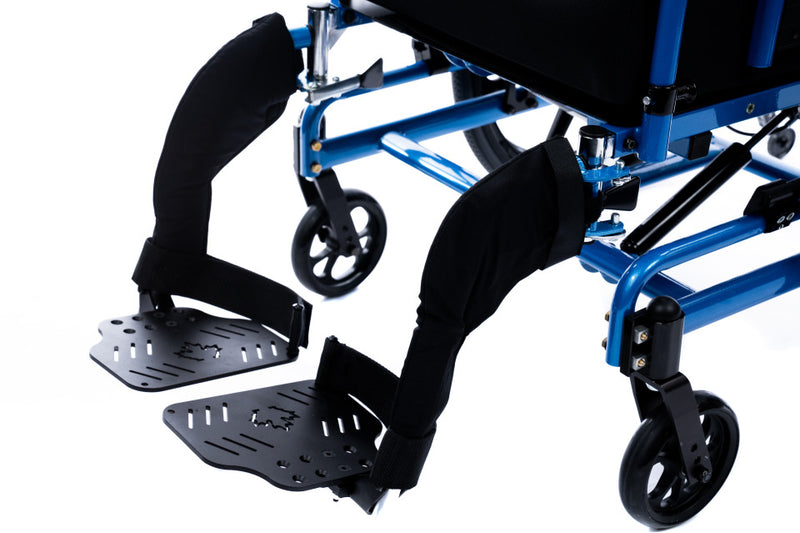
Photographs show representative configurations. Seat size, frame colour, back, cushion, footrests and upholstery are all specified to the individual.
Manual chairs
Six frames covering everything from an inexpensive everyday chair to a 600 lb bariatric build. All made to order.
NRG+
The basic steel-frame chair in the range, and the one most people end up with. It offers real adjustability at the lower end of the price range — a sensible starting point when someone needs a properly fitted chair rather than a specialist one.
Call for pricing ›Swift
The heavy-duty steel frame, rated to weight capacities of up to 600 lb. If a standard bariatric chair has not held up, or the numbers are beyond what most manufacturers list, this is the frame to ask about.
Call for pricing ›EZ Ride
A high-performance aluminium frame weighing under 32 lb fully dressed. That matters for anyone self-propelling all day, and for the family member who has to lift the chair into a car boot several times a week.
Call for pricing ›Access
A steel-frame transport chair built for the volume of use a public institution puts a chair through. Four small wheels and pushed by someone else — the user cannot self-propel it. Sensible where a chair is shared rather than owned.
Call for pricing ›NRG+ Gold
The lightweight aluminium version of the NRG+, with a frame design that allows a seat-to-floor height as low as 12.5 inches. Worth asking about for a shorter user who foot-propels, or where transfers are all sliding.
Call for pricing ›NRG+ Recliner
The NRG+ steel frame with a reclining back added. It fills an awkward gap — someone who needs to change position through the day but does not need a full tilt chair, and would find one too large for the home.
Call for pricing ›It usually comes down to three things: how much the chair has to carry, whether the person propels it themselves, and how often it has to be lifted into a car. Tell us those on the phone and we will narrow six frames down to one or two before anyone fills in a form.
Commodes
Five frames, from a folding travel commode to a 750 lb heavy-duty build.
reFresh
The newest design in the commode range, available on a tilt frame and fully height adjustable from 19 to 24 inches. That adjustment range is the useful part — it lets one frame work over a low toilet, a standard one, or a raised seat.
Call for pricing ›HD Commode
The basic bathroom commode chair, which also happens to carry up to 750 lb — the highest capacity in the range. Customisable to fit awkward bathrooms, which is usually where these get difficult.
Call for pricing ›Tilt Commode
The adult tilting commode, specified across a wide range of sizes with a heavy-duty package available. Tilt matters here for the same reason it does on a wheelchair — it holds someone securely who cannot hold their own position.
Call for pricing ›Jr Tilt Commode
The paediatric version, with a smaller seat area on a base that still fits over a standard toilet. That combination is the point — a child-sized seat that does not require the bathroom to be rebuilt around it.
Call for pricing ›Escape
A folding travel commode with a removable soft seat and a cross-brace design that lets it fold flat for storage. The one to ask about for a trip, a second home, or a small flat with nowhere to leave a frame standing.
Call for pricing ›Commodes fail on room dimensions more than on the chair itself. The three numbers worth having before you call: the width of the bathroom doorway, the distance from the toilet to the nearest wall on each side, and the height of the toilet seat. A frame that rolls over the toilet needs clearance on both sides, and a raised seat already fitted can put the whole thing out of range.
The rest of the range
Same manufacturer, same warranty, same build-to-order process.
Walkers
Support walkers from the same Canadian manufacturer, for people who need more than a standard rollator provides. If a stock rollator would do the job we will tell you — we carry those in the showroom.
Call for pricingSeating — backs, cushions, headrests
Contoured and flat profiles across a range of sizes, including the Fusion line of backs and multi-axis headrests. Specified to the person rather than to the chair, and often orderable for a chair already in service.
Call for pricingAccessories
Articulating legrests, angle-adjustable footplates, padded leg straps, leg bolsters, arm troughs, gel arm pads, fender protectors, IV poles, oxygen tank holders and slide-on trays. Most are specified with the chair, but many can be added to an existing one.
Call for pricingParts
Replacement parts for Maple Leaf chairs already in use — casters, footplates, upholstery, hardware. Tell us the model and what needs replacing and we will source it rather than sell you a new chair.
Call for pricingPeople often spend weeks choosing between chairs and then take whatever cushion comes with it. For someone sitting six or more hours a day it is usually the other way round: the back, cushion and headrest do more for comfort and skin protection than the frame model does. Maple Leaf builds backs, cushions and headrests in contoured and flat profiles, and we specify them as part of the same order.
A tilt chair with a 14-inch seat, a standard back and pin footrests is a different price from the same chair at 18 inches with a Fusion back, articulating legrests and a heavy-duty package. Putting one number on the page would be wrong for almost everybody who reads it. We would rather take five minutes on the phone, understand what is actually needed, and quote you something accurate — including what your extended health plan or Ministry funding is likely to cover.
How a special order works
About three weeks from approved order form to delivered chair.
Tell us the situation
Who it is for, what they can and cannot do, and where it has to fit. An OT assessment helps but is not required to start.
The order form
You or your therapist complete the specification form — seat width and depth, back, cushion, wheels, footrests. This is what the chair gets built to.
Built in Canada — about 2 weeks
Maple Leaf manufactures the chair to that specification. You also get a written quote for any funding application before we order.
Delivered and fitted — 5 to 7 days
Shipping to us, then we deliver, set it up, adjust it to the person and show any caregivers how it works.
Is a special order the right answer?
Sometimes it is not, and we would rather say so before you wait three weeks.
Order it in
- The person will use it daily for months or years
- Posture, pressure or weight puts a stock chair out of range
- An OT has specified something a standard chair cannot do
- Funding is being applied for and the spec must be exact
Take something from stock instead
- It is needed this week — a discharge or a sudden change at home
- It is for a recovery period measured in weeks, not years
- A stock size genuinely fits — many people a standard chair suits
- Renting first would settle whether it is the right type at all
Send a special order enquiry
Or call 604-240-2450 — the phone is answered 24 hours a day and is usually faster.
Frequently asked questions
Timelines, funding, measurements and what happens if it does not fit.
How long does a special order take?
Maple Leaf is a custom build manufacturer — only basic frames are held in stock and everything else is made to the specification on the order form you or your therapist complete. Manufacturing typically takes 2 weeks, then a further 5 to 7 days for delivery to you. If the equipment is needed sooner than that, tell us: we can often rent you something suitable to bridge the gap while the ordered chair is being built.
Why can I not just see a price?
Because the same chair can differ by well over a thousand dollars depending on how it is specified — seat size, back type, cushion, footrests, weight capacity and upholstery all change the figure. A single price on a web page would mislead nearly everyone reading it. Call 604-240-2450 or send the form above and you will get a real number for the actual configuration.
How much tilt does each chair give?
The SuperTilt reaches 45 degrees, the MLT 35 degrees, the MLTR 30 degrees, and the LowRider 20 or 30 degrees depending on how the seat height is set. Both the MLT and MLTR include a reclining back as standard. More tilt shifts more weight off the sitting bones, so where pressure is the main concern the SuperTilt leads; where transfers or seat height dominate, the LowRider does.
What is the difference between the MLT and the MLTR?
The MLT gives slightly more tilt at 35 degrees against 30, and comes in three fixed seat depths. The MLTR adjusts infinitely from 15 to 19 inches, arrives with complete seating and a locking tray included, and is two inches wider. In short: the MLT suits one person using it long term at home, the MLTR suits a hospital or rehab unit where the same chair has to fit a different person each week. The frame codes also run opposite ways — MLT700A has rear wheels while MLTR600 does — so check twice on an order form.
What is the difference between tilt and recline?
Tilt rotates the seat and back together as one unit, so the hip and knee angles stay the same while weight comes off the sitting bones. Recline opens the hip angle by dropping the backrest away from the seat. Tilt is generally better for pressure relief because it does not drag the skin against the back; recline is often more comfortable for long rests and easier for some personal care. Several Maple Leaf chairs offer both, and which one leads should follow the assessment.
Will the chair fit through my doorway?
Work it out from the seat width, and note that it differs by chair. The SuperTilt and LowRider are about 9 inches wider overall than their seat width. The MLT is 10 inches wider with large rear wheels or 6 with four casters. The MLTR is the widest at 12 and 8 — an 18-inch MLTR is 30 inches across with rear wheels. Measure the narrowest doorway on the route from the front door to where the chair will live, including any hallway turn, and tell us the number before we finalise the order.
Do I need an occupational therapist assessment?
Not to start a conversation with us. But for anything complex — pressure management, postural support, or a funding application — an OT assessment makes the specification far more likely to be right, and Ministry funding generally requires one. Your therapist can also complete the manufacturer's order form directly. If you do not have an OT involved yet, we can tell you how that referral usually happens.
How do I measure for seat width and depth?
Roughly: seat width is measured across the widest point of the hips and thighs while seated, with a small allowance added so the person is not squeezed; seat depth runs from the back of the buttocks to just behind the knee, stopping short so nothing presses into the back of the leg. Both are easy to get slightly wrong, and a chair that is too wide costs stability and pushes the hand rims out of reach. We take the measurements ourselves before anything is ordered.
Will extended health or Ministry funding cover it?
Sometimes, and often partially. MSP generally does not fund mobility equipment. Funding tends to come through Ministry programs (BCEA/PWD), extended health plans, ICBC or WorkSafeBC. The critical rule with Ministry funding is that approval must come before the equipment is purchased — buying first and claiming afterwards is the most common reason applications fail. Note that funding approval usually takes longer than the three weeks the chair itself needs, so start that process early. We provide the quotes and documentation these applications need.
What if it arrives and does not fit properly?
We deliver and fit it in person, and adjustments within the chair's range — footplate height, back angle, armrest position, headrest placement — are part of that visit. Where something has been specified wrongly we work with the manufacturer to put it right. Because these chairs are built to order rather than picked off a shelf, this is why we take the measurements carefully at the start rather than guessing.
Can I pay for a special order over time?
Yes. Our in-house financing is 0% interest with no credit check, split over 3, 6 or 12 months with a 10% deposit. You can estimate the payments on our payment calculator once you have a quote.
Talk it through with someone who has specified these before
Five minutes on the phone will tell you more than an hour of reading. Call any time, or come to the showroom and see a standard chair before deciding whether a custom one is warranted.
- Showroom: 12987 80 Ave, Surrey, BC V3W 3B1
- 604-240-2450
- info@mustmedical.ca
- Open 24 hours, 7 days a week


Swift in detail
Click any photograph to enlarge, then use the arrows to move through the set.